
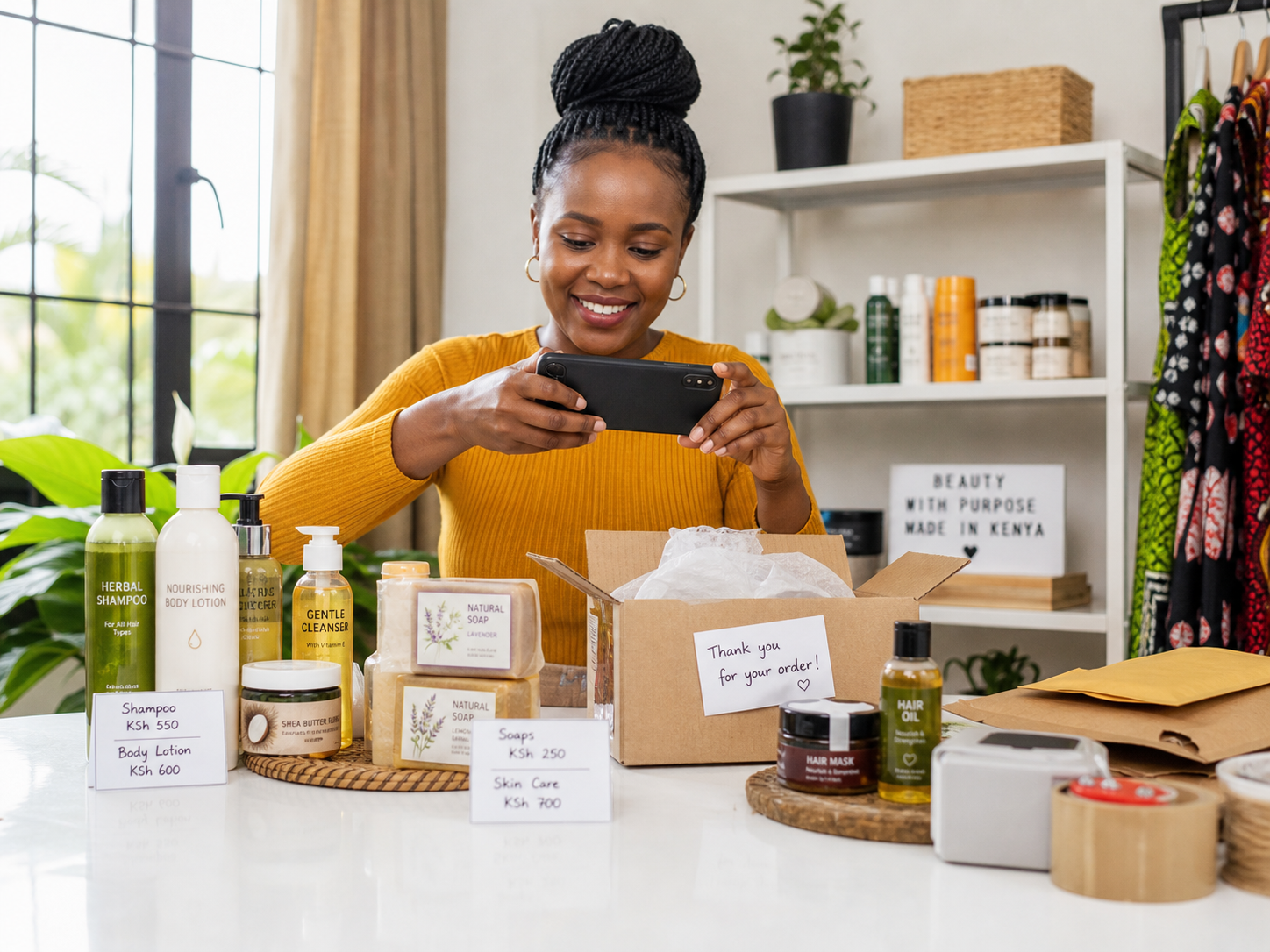
How to Sell Personal Care Products in Kenya on Social Media in 2026
Why does a buyer tap your status, ask the price, then vanish? That silence is money you already spent on content, and customers you never get back. The answer is simple: list your personal care products in Kenya on TikTok, WhatsApp, Instagram or Facebook, using a business profile, a product catalogue and a payment link that accepts M-Pesa, then share that link across your channels.
Why social commerce is the fastest route for personal care products in Kenya
Kenyan buyers discover soap, lotions, hair care, and skincare items through short videos, influencer demos, and WhatsApp statuses before they ever visit a website. Social commerce lets you tap into that behaviour by turning a post or a chat into a completed sale.
Personal care products are well suited to social selling because they are visual and emotional. A 30-second TikTok video showing how a body butter absorbs into the skin does more than any written description. When you sell through social channels, you also collect customer questions, testimonials, and repeat orders in the same thread, which helps you refine your product range.
How to list personal care products on social media in Kenya
The question "how can Kenyan sellers list personal care products" has a practical answer: choose your channels, build a catalogue, and publish product links. You do not need to build a store from scratch when you can use a ready-made selling flow.
Step 1: Register and formalise your business
Before you list products, register your business name through the Business Registration Service Kenya so you can get a KRA PIN. A PIN is required for M-Pesa paybill setup, issuing invoices, and staying compliant with the Kenya Revenue Authority when your sales grow.
Step 2: Choose your product range
Start with 5 to 10 personal care products that share a theme. For example, a shea butter range, an organic hair oil line, or a men's grooming set. A narrow range makes your catalogue easier to price and your social content easier to plan.
Step 3: Build your catalogue
You can list products directly on a social commerce platform in Kenya. For instance, the LinkDuka how-it-works flow lets you create product listings with photos, descriptions, and prices in minutes, then generates a shareable link. The same link can be posted to TikTok, WhatsApp, Instagram, and Facebook without duplicating work. You can also browse product categories on LinkDuka to see how other Kenyan sellers group their personal care items.
Step 4: Publish product links on your social channels
When you post product links, pair them with content that answers a buyer's question. A skincare listing should mention skin type, ingredients, and results. A hair care listing should mention the hair texture it suits and how often to use it.
Pro tip: Use the same product photos and pricing across every channel. Kenyan buyers compare prices on WhatsApp and Instagram before they buy, and inconsistent pricing damages trust faster than a slightly higher price.
Where to sell: social platform options compared
Different platforms suit different personal care products and customer behaviours. Here is how the main options compare for Kenyan sellers in 2026:
| Platform | Best for | Selling format | Payment fit |
|---|---|---|---|
| TikTok | Video demos, viral discovery | Bio link, TikTok Shop, product link | M-Pesa via link or checkout |
| WhatsApp Business | Personal service, repeat orders | Catalogue, status updates, chats | M-Pesa, direct chat orders |
| Visual branding, skincare and makeup | Instagram Shop, link in bio, DMs | M-Pesa via link or checkout | |
| Community selling, older buyers | Marketplace, shop, groups | M-Pesa via link or checkout | |
| X (Twitter) | Announcements, flash sales | Product links in posts | M-Pesa via link |
You can manage Facebook and Instagram listings together through Meta Business Suite, which keeps product inventories and messages in one dashboard. For TikTok, TikTok for Business offers advertising and shop tools if you want to push a specific product to a wider audience.
How to price personal care products for the Kenyan market
The question "how can Kenyan sellers price personal care products" comes down to covering costs, matching market expectations, and leaving room for promotions. Your price must also look believable to buyers who routinely check multiple sellers.
Cost-plus pricing
Add up every cost: raw materials, packaging, labelling, transport, M-Pesa transaction fees, packaging inserts, and your time. Multiply that total by at least 2 to get your wholesale price and by 2.5 to 3 for retail. If your selling price is below this multiple, you are effectively subsidising your customers.
Competitor-based pricing
Search the same product name on Instagram, TikTok, and WhatsApp catalogues to see the current price band. In 2026, a 250 ml Kenyan-made body lotion typically sits between KSh 350 and KSh 800 depending on ingredients and brand prestige. A handmade soap bar ranges from KSh 150 to KSh 400. Use these ranges as a reference, not a ceiling.
Psychological price points
Retail prices ending in 50 or 00 work well for personal care in Kenya. KSh 200, KSh 350, and KSh 500 are easy for buyers to calculate, especially when they are paying via M-Pesa and need to confirm the amount aloud. Bundle deals, like "three soaps for KSh 500", also increase average order value without lowering your perceived quality.
What to look for when choosing a pricing model
- Look for a model that covers delivery losses. Personal care products spill, leak, or melt in transit, so build a 3 to 5 percent buffer into your price.
- Look for a model that allows monthly promotions. Kenyan buyers love a "M-Pesa offer" weekend, so your base price should still leave margin at a 15 percent discount.
- Look for a model that is easy to update. If you list on a social commerce platform, ensure you can change prices in seconds and republish your links.
What you need to start selling personal care products online
Before your first sale, gather these essentials:
- A registered business name and KRA PIN
- A dedicated phone number for buyer communication
- Product photos on a plain or neutral background
- Packaging that survives courier and boda boda delivery
- An M-Pesa paybill or till for receiving payments
- A product link page or social commerce storefront
- A simple record sheet for sales, costs, and customer details
Setting up payment is straightforward. The LinkDuka sell products with M-Pesa guide walks you through connecting your M-Pesa business number to your product links, so buyers can pay without leaving WhatsApp or TikTok. You can also read how to accept M-Pesa for a broader look at payment flows and buyer confirmation steps.
Common mistake: selling personal care products without mentioning ingredients and expiry. The Kenya Bureau of Standards expects consumer goods to carry clear labelling, and buyers are more likely to trust a listing that states what is inside the jar.
How to handle customer data and compliance
As your buyer list grows, you are collecting names, phone numbers, locations, and payment records. Under Kenyan law, this makes you a data controller, and the Office of the Data Protection Commissioner Kenya expects you to handle that information responsibly. In practice, this means asking consent before adding buyers to a broadcast list and never sharing customer numbers with third parties.
For tax, keep a simple spreadsheet of every sale. If your turnover crosses the VAT threshold, the Kenya Revenue Authority will expect proper invoices, so build that habit from day one. Use the free VAT calculator to add 16% VAT to a price or remove it from a total.
Getting started: your next steps
You can go from zero to your first personal care product sale this week.
- Register your business name and get a KRA PIN through the Business Registration Service Kenya portal.
- Choose five to ten products and photograph them on a clean background.
- Set your prices using the cost-plus method, then check them against current Instagram and TikTok listings.
- Create your catalogue on a social commerce tool like the LinkDuka sell online in Kenya hub to generate product links.
- Connect your M-Pesa paybill or till to your LinkDuka storefront so payments are automatic.
- Post your first product link on WhatsApp status, TikTok, and Instagram with a short demo video.
- Respond to every comment and DM, and record your first orders in a simple spreadsheet.
As you grow, expand into Google Business Profile so customers can find your personal care brand through local search, and keep a close eye on Communications Authority of Kenya updates if you plan to run SMS campaigns or premium rate promotions.
The Kenyan personal care market is built on trust, word of mouth, and social proof. By listing your products where your customers already spend time, pricing them honestly, and accepting M-Pesa through a reliable checkout, you position your small business for steady repeat sales. For more practical advice on Kenyan social commerce, keep exploring the LinkDuka blog. Start with one product line, one platform, and one payment link, then scale what works.
Was this post helpful?
Discussion
Comments