
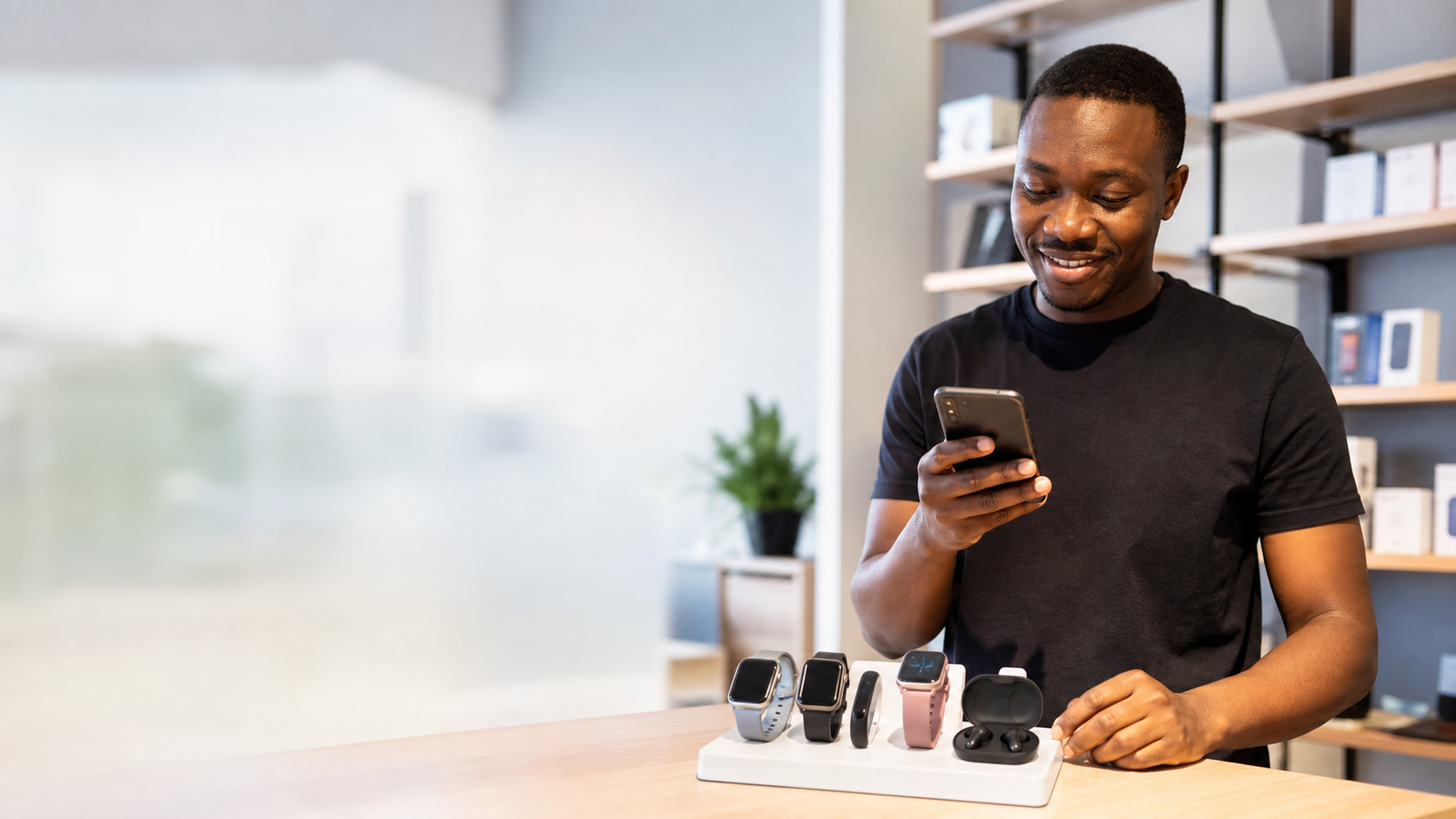
"Bei ngapi?" You reply. Then silence. Each stalled chat leaves a smartwatch or earbuds sitting in stock while a faster seller takes the money. Sell wearables in Kenya by linking your TikTok, Instagram, WhatsApp and Facebook posts straight to an M-Pesa checkout, so buyers see a short demo, check a clear price and pay inside the chat.
Why Wearables Are a Hot Category on Kenyan Social Commerce
Wearables products in Kenya have seen a surge in demand since mid-2026, driven by health-conscious consumers, remote workers, and tech enthusiasts. Smartwatches from brands like Amazfit, Huawei, and Xiaomi, as well as affordable fitness bands and TWS earbuds, are frequently searched on TikTok and Instagram. The commercial intent is high: buyers want to see a product in action, compare prices, and complete a purchase without leaving their chat app.
Using a social commerce platform like LinkDuka allows you to create a single product link that works across all your social channels. Instead of directing customers to a website that takes too long to load on mobile, you send them a link that opens an M-Pesa checkout instantly. This is how many successful Kenyan resellers are moving wearables stock weekly without holding a physical store.
Choosing the Right Social Platforms for Wearables
Not every platform works equally for wearables. Here is a quick comparison based on what works best in Kenya in 2026:
| Platform | Best for Wearables | Key Feature | Payment Integration |
|---|---|---|---|
| TikTok | Short demo videos, unboxings, before/after | Shoppable videos with product links | M-Pesa via LinkDuka link |
| High-quality product photos, Stories | Instagram Shop + link in bio | Direct checkout with payment link | |
| Price lists, direct inquiries, repeat buyers | Broadcast lists + catalog | M-Pesa payment via shared link | |
| Marketplace listings, local groups | Facebook Shop + Marketplace | Checkout with mobile money | |
| X (Twitter) | Flash sales, trending hashtags | Short product tweets with links | Payment link in tweet |
Pro Tip: Most Kenyan buyers will first see your product on TikTok or Instagram, then move to WhatsApp to ask for the price list. Have your WhatsApp Business catalog ready with wearables product photos, prices, and a LinkDuka payment link attached to each item.
How to Set Up Your Wearables Product Listings with Pricing
When a potential buyer asks "how can Kenyan sellers wearables products Kenya price list?" you need to respond instantly. The best approach is to create a digital price list that updates automatically and can be shared as a link.
Step 1: Gather Your Wearables Inventory
List each product with the following details:
- Product name (e.g., Amazfit Bip 5 Smartwatch)
- Description (key features: battery life, water resistance, heart rate monitor)
- Your selling price in KES (include any discount for repeat buyers)
- Stock status (available, limited, pre-order)
- High-quality images (front, back, wrist shot, packaging)
Step 2: Create a Price List in Your Social Commerce Tool
Instead of sending a PDF that looks outdated, use a platform that generates a mobile-friendly page. For example, with LinkDuka, you can create a product link for each wearable item. Group them into a collection called "Wearables Kenya - Price List June 2026" and share that single link on WhatsApp, Instagram bio, or TikTok.
Step 3: Price Competitively but Include Value
In 2026, common wearables products Kenya prices range as follows (these are example ranges based on recent market data):
- Basic fitness band: KES 1,500 - 3,000
- Mid-range smartwatch (Amazfit, Huawei): KES 5,000 - 12,000
- Premium smartwatch (Apple Watch, Samsung): KES 20,000 - 60,000
- True wireless earbuds: KES 2,000 - 8,000
Common mistake: Avoid listing prices lower than your cost just to attract views. Instead, highlight value - for example, "Free delivery within Nairobi" or "1-year warranty included."
Step 4: Respond to "For Sale" Queries with a Direct Link
When a buyer comments "wearables products Kenya for sale" on your post, reply with your product link immediately. If you are on WhatsApp, use the catalog feature to send the exact product. Always include the price in the message so the buyer doesn't have to click to see it - that builds trust.
Pricing and Payment: Accepting M-Pesa and More
The most important part of selling wearables on social commerce in Kenya is making payment easy. Over 90% of Kenyan online buyers use M-Pesa. If your checkout requires a credit card, you will lose sales.
How to Set Up M-Pesa Checkout for Wearables
You need a system that generates a unique M-Pesa paybill number for each order. LinkDuka integrates directly with Safaricom M-Pesa so that when a buyer clicks your product link, they see the price and can pay via M-Pesa in seconds. The funds go directly to your registered Lipa Na M-Pesa till number or paybill.
Creating a Price List with M-Pesa Links
For each wearable product, create a separate product link or a combined list. Example:
| Product | Price (KES) | Buy Link |
|---|---|---|
| Amazfit Bip 5 | 7,500 | [Pay with M-Pesa] |
| Huawei Band 8 | 4,200 | [Pay with M-Pesa] |
| Baseus Bowie Earbuds | 2,800 | [Pay with M-Pesa] |
Share this table on WhatsApp or Instagram Stories. When the buyer taps "Pay with M-Pesa," they are taken to a checkout page that shows product details, your business name, and a Paybill number.
Pro Tip: After payment, automatically send a confirmation message via WhatsApp with the tracking number if you use a courier. That reduces "Where is my item?" messages.
Pro Tips for Selling Wearables on Social Media in Kenya
Based on what is working for top sellers in 2026:
- Use video demos, not just photos. A 30-second TikTok showing the watch face, step counting, and notification mirroring sells more than 10 static images.
- Leverage user-generated content. Ask buyers to send a photo wearing the smartwatch, then repost it (with permission). Social proof is gold.
- Offer a payment plan. "Pata KES 2,000 deposit, pay balance in 2 weeks via M-Pesa" - this works especially for wearable items above KES 5,000.
- Include a warranty statement. Mention "7-day return if defective" in your product description to reduce hesitation.
- Tag your location in Google Business Profile so local buyers can trust you are a real business.
What You Need to Get Started Selling Wearables in Kenya
Complete this checklist before you launch your social commerce campaign:
- Business registration - Register your business name via Business Registration Service Kenya for credibility. Many wholesale suppliers require a registered business.
- KRA PIN - For tax compliance when you hit certain revenue thresholds. You can issue invoices using your PIN.
- KEBS standards - If you are importing wearables, ensure they meet Kenya Bureau of Standards requirements. Earbuds and smartwatches with batteries must have proper certification.
- M-Pesa integration - Set up a Lipa Na M-Pesa till number or paybill. Use a platform like LinkDuka to connect it to your product links automatically.
- Data protection compliance - Since you will collect buyer phone numbers and names, register with the Office of the Data Protection Commissioner Kenya and add a privacy statement on your checkout page.
- Social media business accounts - Convert your TikTok, Instagram, and Facebook to business profiles. Use Meta Business Suite to manage Instagram Shop and Facebook Shop.
- Product sourcing - Find reliable suppliers for wearables. Many Nairobi-based distributors now offer dropshipping or wholesale for Amazfit, Huawei, and generic brands.
- Price list ready - Create a digital price list (via LinkDuka or Google Sheets) that you can share as a link.
Getting Started with LinkDuka for Wearables
If you are ready to start selling wearables products in Kenya through social commerce, LinkDuka gives you the essential tools in one place. You can:
- Create a product link for each wearable item - perfect for sharing on TikTok, Instagram, and WhatsApp.
- Integrate M-Pesa checkout so buyers pay without leaving the conversation.
- Build an online shop that looks professional even if you only sell from your phone.
- See all your orders and payments in one dashboard.
- Upgrade to a pricing plan that suits your volume.
Visit the how it works page to see the step-by-step setup, or check pricing to find a plan that matches your monthly sales. Many sellers start with the free tier and upgrade after their first 20 orders.
If you need a broader overview of selling online, read the Sell online in Kenya guide. For payment-specific advice, see Accept M-Pesa and Sell products with M-Pesa.
Next Steps
The market for wearables products in Kenya is still growing, and social commerce is the fastest way to capture buyers. Your task this week:
- Choose 3 - 5 wearable products you can source immediately.
- Take short video demos for each.
- Create a product link on LinkDuka with pricing and M-Pesa checkout.
- Post on TikTok and Instagram using relevant hashtags like #WearablesKenya #SmartwatchKE #FitnessBandKE.
- Respond to every inquiry with your price list link.
By following this structure, you will turn social media followers into paying customers without needing a website or a physical shop. The tools are ready - start linking your wearables today.
Was this post helpful?
Discussion
Comments