

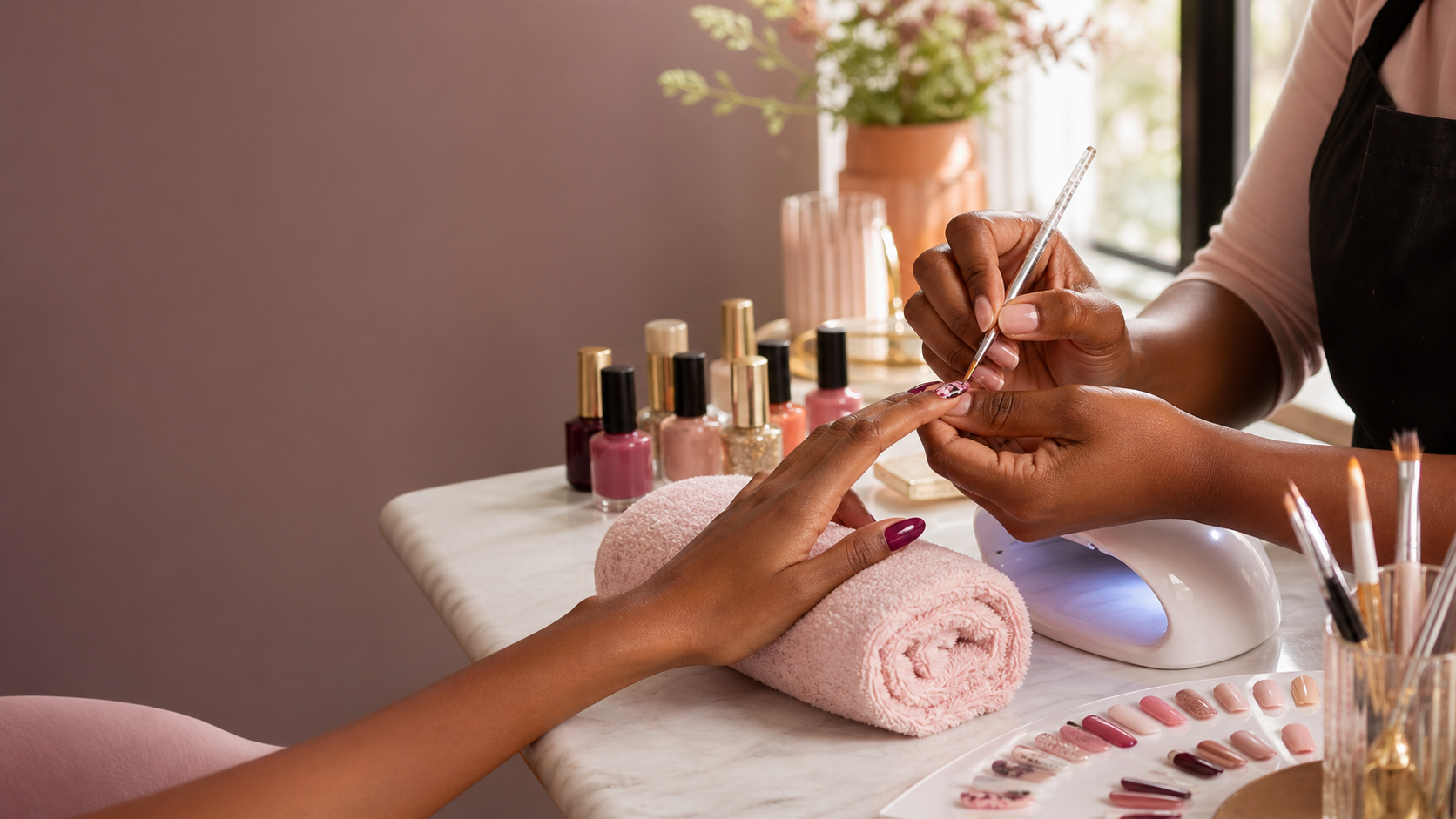
Nail Art Service Kenya: Book Without Wasting Money
"Bei gani?" A client asks, then goes quiet when your figure lands. Every vague enquiry and mismatched booking burns hours you could spend on paying clients. A good nail art service in Kenya rests on three visible things: clear pricing, hygiene a client can check, and a portfolio showing exactly what the money buys.
What Should I Look for in a Nail Art Service?
Choosing a nail art service is not just about finding the prettiest pictures on Instagram. The right service balances skill, professionalism, and the condition of your natural nails.
First, look at the technician's level of training. In Kenya, there is no single mandatory licensing board for nail technicians, so standards vary. Ask where the technician trained, what products they use, and how long they have practiced. A good technician can speak confidently about different nail systems - gel, acrylic, dip powder, or press-on - and explain why one might suit your nails better than another.
Second, look for a portfolio. A technician who is proud of their work will often have an album, either physical or digital, showing their past designs. Examine the quality honestly: look at the cuticles, the symmetry of the shapes, and the smoothness of the polish application. If their portfolio shows the same style repeatedly, that is fine if you want that style. But if you want variety, look for someone who demonstrates versatility.
Third, assess their professionalism in communication. How quickly do they respond to enquiries? Do they answer questions about pricing and hygiene clearly? A good service provider treats your questions with patience, not irritation. If a technician is vague or dismissive before you have even booked, that is an early warning sign.
How Do I Check Hygiene Before Booking?
Hygiene is the single most important factor in nail care. An unclean salon can expose you to fungal infections, bacterial growth, or even blood-borne risks if tools are shared carelessly.
Before booking, call or message the salon and ask direct questions. Do they sterilise tools between clients? Do they use an autoclave for metal implements? Are new nail files and buffers used for each client or properly disinfected? A reputable technician will answer these questions without hesitation.
When you arrive for your appointment, do your own inspection. Watch how the technician prepares their station. Tools should be taken from a sealed sterile pouch or visibly cleaned in front of you. The technician should wash their hands before beginning and should not have open food or drink near the workspace. Check whether the salon has proper hand-washing facilities and a clean, tidy environment overall. Pay attention to the smell of the salon; a strong chemical odour may suggest poor ventilation.
Red flags include torn or dirty linens, reused cotton wool, containers with no lids, or a technician who refuses to let you watch them prepare tools. Trust your instincts. It is acceptable to leave an appointment if you feel the hygiene is unacceptable.
How Do I Choose a Nail Art Design?
Choosing a design is a personal decision, but making the right choice starts with context. Consider your daily routine, your workplace dress code, the season, and the occasion you are dressing for.
Your lifestyle matters most. If you work with your hands, perform manual tasks, or type frequently, longer nails or heavy 3D embellishments may be impractical. In this case, a shorter, neatly shaped nail with minimalist art - thin lines, dots, or a single accent nail - is often more sensible. If you have an event such as a wedding, a graduation, or a business launch, you can afford a bolder look, but choose a design that matches your outfit rather than competing with it.
Skin tone and nail shape also influence how a design appears. Try to visualise the artwork on your actual hand, not just on a model in a photo. Many technicians are willing to sketch a plan or suggest colours that will flatter your skin tone. If you see a design you like online, save it and bring it with you - but be prepared for your technician to adapt the design to your nail length and natural nail health.
Think about maintenance too. Intricate hand-painted art and heavy rhinestones will grow out noticeably within two to three weeks. If you cannot commit to regular infill appointments, choose a design that still looks elegant as it grows.
Comparing Nail Art Providers in Kenya
Kenya's nail market has several types of providers: established beauty salons, freelance technicians operating from home or mobile studios, and specialised nail bars. Each has its strengths, and your choice depends on your priorities.
Established salons often offer convenience and a broader range of services. If you want a pedicure, facial, and nail art in one visit, a full-service salon is practical. However, these salons may have busier environments where your technician is rotating between clients.
Freelance technicians often provide more personalised attention. Some operate from a dedicated corner of their home or offer mobile services for events. They tend to have lower overheads, which may result in more competitive pricing, but you must verify their hygiene standards even more carefully, as they lack the oversight of a physical salon.
Specialised nail bars focus entirely on nails. These providers often invest heavily in professional-grade products and training, which may lead to higher prices but also higher-quality results.
When comparing providers, examine their price lists openly. Some charge for the service type only, while others add charges for length, design complexity, or hand-painted details. Ask for a breakdown before you commit. Also examine their cancellation policies and their guarantees. Few technicians will guarantee nail art against breakage, but many will offer to repair a nail that lifts or chips within a short period - this is a sign of confidence in their work.
Pricing and Value in Nail Art Services
Pricing for nail art in Kenya varies widely based on location, expertise, product quality, and design complexity. A basic manicure or plain gel polish in an urban salon will understandably cost less than an elaborate, hand-painted set with chrome or 3D effects at a high-end nail bar.
Rather than focusing only on the lowest price, evaluate value. Cheap services may use low-grade products that damage the natural nail or lift within a matter of days. Overpriced services do not automatically guarantee quality either. The best benchmark is the technician's reputation, as evidenced by repeat clients and honest reviews.
Be wary of price estimates that seem too good to be true, particularly for techniques like extensions or sculpted nails that consume significant time and material. You should also budget for maintenance. Nail enhancements generally need refills or removals every two to four weeks. Some salons offer a loyalty discount or package deal for monthly clients - ask what options exist so you can project your ongoing costs.
How Can I Book a Nail Appointment Online?
Booking a nail appointment in Kenya has become far more convenient with the growth of digital tools. Many salons now use WhatsApp for booking, while others have embraced booking platforms that streamline the process.
The most efficient approach is to use a service that allows you to see real-time availability. LinkDuka is a platform that enables local businesses to list their shops, services, and booking links in one place. For a customer, that means you can browse a nail provider's offerings and book an appointment without endless phone tag. For a business owner, it offers an organised way to manage bookings and present services professionally.
Whichever method you choose, follow a few simple guidelines when booking online. Provide your full name, contact number, and the exact service you want. If you have a design in mind, attach a reference photo with your booking message. Confirm the appointment time, venue, and expected duration. Ask about their policy on lateness - some busy salons will cut your service short if you arrive late, or charge a late fee. Finally, save the confirmation and set a reminder. A few days before your appointment, a quick message reconfirming is good practice for both parties.
Customer Preparation: Getting Ready for Your Appointment
Proper preparation on your side helps your technician produce a flawless result that lasts longer.
A few days before your appointment, hydrate. Drink water and apply cuticle oil or moisturiser to your hands and nails. Well-hydrated skin and cuticles make the preparation process easier and reduce the chance of ragged cuticles or lifting between the product and nail plate.
On the day of your appointment, arrive with clean, dry hands. Avoid applying lotion or hand cream immediately before your appointment, as oily residue can prevent polish and gel from adhering properly. Remove any old polish before you arrive if you can, or inform the technician in advance so they can allocate time for removal. If you wear nail extensions from a previous set, note that old product removal is a service that takes time and may have an additional charge.
Communicate any allergies, sensitivities, or existing nail conditions before you begin. If you have a fungal issue, a damaged nail, or an infection, postpone the appointment and seek medical advice. Nail art should be applied to healthy nails only.
Nail After-Care: Protecting Your Investment
The way you treat your nails in the days following your appointment determines how long the art will live. Nail polish may look durable, but it needs cooperation from you.
Avoid using your nails as tools - do not use them to open cans, scrape stickers, or pick at things. When doing household chores that involve water or cleaning chemicals, wear gloves. Water absorbed by the natural nail can cause lifting of the enhancement. Be gentle with your cuticles; push them back softly after a shower if needed, but never cut them aggressively.
Moisturise your cuticles daily with a nourishing oil. This not only keeps the surrounding skin healthy but also helps maintain the flexibility of the polish layer. If you notice a chip or a lift, book a repair rather than picking at the product. Picking can remove the top layer of your natural nail, causing long-term damage.
When you are ready to change your design, allow a professional to remove the product safely. Soaking in acetone, when done correctly, protects the natural nail. If you have kept gel or acrylic on for many months without a break, consider a period of natural nail care - trimming, strengthening treatments, and regular moisturising - before your next full set.
How Should a Nail Business Attract Repeat Customers?
For businesses, the difference between a one-time client and a loyal regular lies in the experience you create.
First, prioritise consistency. Clients need to know that every visit will meet the same standard of hygiene, skill, and hospitality. An inconsistent technician who wows one month and disappoints the next will struggle to retain customers. Perfect your craft through continuous practice and refresher training.
Second, make booking easy. If a client must send three messages and wait a day for a reply, you have already lost them to a competitor. Set up clear booking hours and respond within a couple of hours. A booking platform like LinkDuka offers businesses a way to create a clean link for bookings and to showcase their services - this is exactly the kind of frictionless experience that encourages return visits. Use this effectively by keeping your service list up to date and your availability accurate.
Third, build a relationship. Remember your returning clients' preferences: their favourite shape, their preferred colour, their comfort and social style. Greet them warmly, and keep notes that allow you to personalise their next visit. Do not overdo the small talk, but show genuine interest.
Fourth, reward loyalty. A simple points system, a birthday discount, or a free cuticle treatment on every third visit gives clients a tangible reason to return. You can implement this manually via a client card system or through digital tools if you prefer.
Finally, ask for feedback and act on it. If clients mention that their polish chipped early, examine your technique or products. If clients complain about online booking confusion, simplify it. When a customer sees you implement their suggestion, they feel ownership in your business and will stay loyal.
Common Mistakes to Avoid in Nail Art
Both clients and business owners fall into predictable traps. Being aware of them saves money and disappointment.
For clients: do not book based on price alone. A badly applied set can cause nail damage that costs far more to repair than the price difference. Also, resist the urge to request extreme lengths that you are not accustomed to; your nail bed and daily habits may not support it. Another common mistake is not asking about after-care - leave your appointment knowing exactly what to do and what to avoid.
For business owners: the biggest mistakes are often related to cutting corners. Reusing tools without proper sterilisation, buying cheap low-quality products, or rushing appointments to fit in more clients will eventually ruin your reputation. A second major mistake is failing to photograph and document your work. Your portfolio is your strongest marketing asset; capture good photos of every set before the client leaves.
Poor communication is another recurring error. Changing appointment times without notice, not clearly stating pricing, or ghosting client messages will cost you trust. Also, do not over-promise. If you are not confident in a very complex design you have never attempted before, say so honestly and offer an alternative, rather than delivering a subpar result that invites negative reviews.
Conclusion
Nail art services in Kenya are maturing into a professional industry with serious standards. Clients today know that a beautiful nail set should come from clean tools, trained hands, and quality products - not merely from a viral photo. As a customer, protect yourself by asking the right questions before you book, and by treating your nails with respect after you leave the salon.
As a business owner, differentiate yourself through hygiene, honesty, skilful craftsmanship, and convenience. Make booking simple for your clients, serve them warmly, and give them reasons to come back. Whether you connect with clients through word of mouth, social media, or an organised booking platform like LinkDuka, the fundamentals remain unchanged: excellent work, safe practices, and reliable service will always attract and keep customers.
To present your services and booking options clearly, see beauty and cosmetics services in Nairobi.
Was this post helpful?
Discussion
Comments