
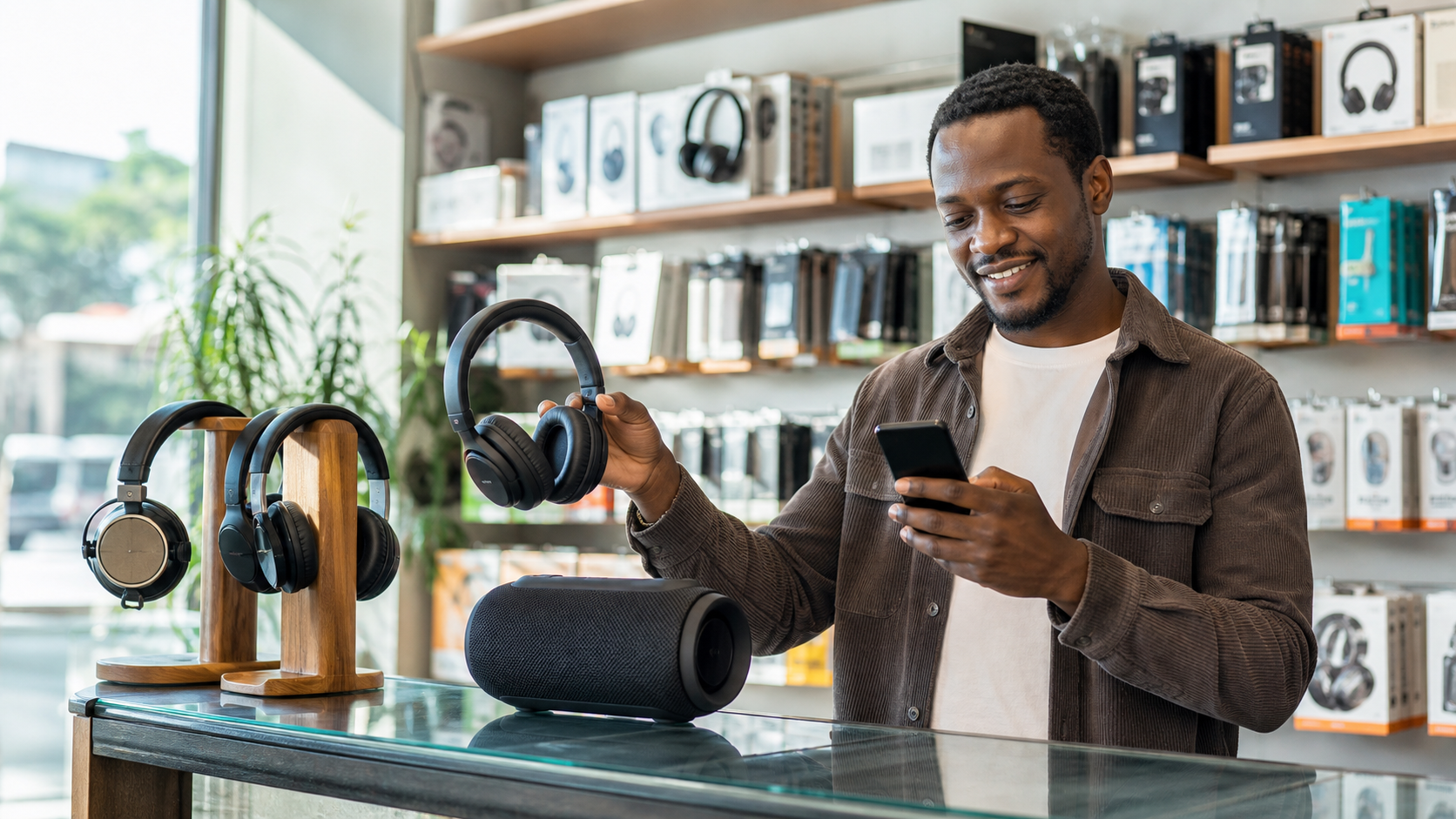
"How much?" You reply. Then silence. That gap loses you both the sale and the buyer, because a faster seller already answered or made paying simpler. Selling headphones and speakers online in Kenya works through social commerce: post a short demo on TikTok or Instagram, handle questions on WhatsApp, then send a product link that ends in an M-Pesa payment.
Start where your buyers already are
Most Kenyan shoppers discover electronics on social media before they search anywhere else. They see a speaker in a TikTok video, ask for the price on WhatsApp, then decide whether to trust the poster enough to send money. Your job as a seller is to make that decision easy.
Social commerce in Kenya works across four main channels:
- TikTok - short demo videos show battery life, sound quality, and portability better than photos. TikTok for Business offers tools if you want to push posts to more buyers.
- Instagram and Facebook - a well-kept Meta shop gives your page a visible catalogue, and Meta Business Suite lets you manage both from one dashboard.
- WhatsApp - where price negotiation, delivery details, and follow-up messages happen.
- X (Twitter) - useful for flash deals, new arrivals, and customer support threads.
The channel matters less than the flow. A buyer should move from "I like this product" to "I have paid for this product" in as few taps as possible.
Build a simple catalogue before you post
You do not need a full website to sell headphones and speakers online in Kenya. You need a clean catalogue and a product link. A product link is a single shareable page that shows one item's photos, price, description, and payment instructions. When a buyer taps it, they should see everything they need without sending you ten follow-up questions.
A practical catalogue entry for a headphone or speaker listing should include:
- Product name with brand and model - "Sony WH-CH520 Wireless Headphones," not "good headphones"
- Condition - brand new, sealed, refurbished, or used
- Key specs - Bluetooth version, battery life, charging time, driver size, and noise features
- What is in the box - cable, case, manual, warranty card
- Price - with delivery included, or clearly marked as excluding delivery
- Delivery timeline - same-day Nairobi, next-day upcountry, or 2-3 days
- Return and warranty terms - in plain language
You can build this catalogue inside a LinkDuka shop and share product links straight into WhatsApp chats, Instagram DMs, or TikTok comments. That keeps your follow-up messages short because the link answers the questions for you.
How to sell headphones and speakers online in Kenya: the full workflow
Here is the workflow that works for small electronics sellers in 2026:
- Test your stock before listing. Play sound on each unit, check charging ports, and record serial numbers. One faulty unit can cost you both the sale and the review.
- Build your catalogue and generate a product link for each model. Group variants like colour so buyers do not have to ask.
- Share the link where your buyers are. Put it in your TikTok bio, Instagram story, or WhatsApp status. Never bury it in a caption.
- Confirm the order in chat. Ask for the delivery location, confirm the price plus delivery fee, and agree on a delivery window.
- Take the M-Pesa payment before dispatch. Once the payment reflects, record it against the order.
- Pack carefully. Headphones and speakers need padding around the drivers and ear cups. Use a box that will not crush the product.
- Send a delivery update. A short message with courier details and an expected arrival time prevents most "where is my order" messages.
Can I accept M-Pesa for headphone and speaker sales?
Yes. M-Pesa is the standard payment method for online electronics sales in Kenya, and buyers expect it. If your checkout does not accept M-Pesa, many buyers will simply stop replying.
You have three realistic options for receiving M-Pesa:
Compare the M-Pesa payment options
| Option | Best for | What you should know |
|---|---|---|
| Paybill | Registered businesses with steady order volume | Shows your business name on the buyer's receipt; a monthly fee applies |
| Buy Goods Till | Small sellers testing a new product line | Low setup cost; payments appear against your till number |
| STK push through a product link | Sellers who want a complete checkout flow | The buyer approves payment from their phone after tapping your link; no need to share a till number |
Safaricom's M-Pesa platform runs the payment rails, and the Communications Authority of Kenya regulates mobile money services in the country. When you sell through a curated shop such as LinkDuka, the checkout connects your product link to M-Pesa so the buyer pays without hunting for your number. For the full setup explained step by step, the Accept M-Pesa guide walks through connecting your shop to mobile money.
Pro tip: Never send goods before the payment reflects in your M-Pesa statement. Scammers often send a fake "payment pending" screenshot to rush delivery. Confirm the money on your phone, then pack.
How should you price headphones and speakers online in Kenya?
Buyers compare prices quickly, but the cheapest listing rarely wins if the seller looks risky. Price to cover your real costs and build trust, not just to undercut everyone else.
Work out your full cost per unit before setting a price:
- Cost of the headphone or speaker from your supplier
- Shipping from the supplier to your store or home
- Packaging materials
- M-Pesa charges or Paybill business fees
- Your delivery cost to the buyer
- A small margin for defects, returns, and lost items
Common mistake: Pricing at cost plus a small mark-up, then discovering that delivery and M-Pesa fees eat the profit. Add delivery as a separate line where possible so buyers see exactly what they pay for.
For used or refurbished units, price at a clear discount to the new retail price and state the condition honestly. Price anchoring also works in social commerce: if you sell three price bands - entry, mid, and premium - most buyers will choose the mid option. Keep one affordable model for first-time buyers and one premium model for buyers who ask for "the best sound."
What should you include in a headphone or speaker listing?
Headphone and speaker buyers cannot test the sound online, so your listing must reduce their risk. Include honest details about:
- Battery performance - real hours you tested, not the manufacturer's best-case number
- Build quality - plastic vs metal, weight, and comfort for long listening sessions
- Connectivity - which Bluetooth version and whether it pairs with two devices at once
- Noise isolation vs noise cancellation - these are different, and buyers often confuse them
- Warranty - exactly what you will do if the unit fails in the first month
Products sold in Kenya should also meet the standards set by the Kenya Bureau of Standards (KEBS). If you import headphones and speakers, check the relevant product standards and quality mark requirements before advertising a feature you have not tested. Once your business grows, keep purchase and sales records tidy because the Kenya Revenue Authority requires business income reporting and proper invoicing for compliant operations.
Which delivery steps help with headphone and speaker delivery?
Delivery is where online electronics sales succeed or fail. Headphones and speakers are fragile, and buyers in Nairobi expect speed while upcountry buyers expect clear timelines.
Practical delivery steps:
- Confirm the exact delivery location before payment - estate, building, and a nearby landmark.
- Charge a delivery fee you state clearly in the listing or in the chat before payment.
- Use a trackable courier for items above a value you are comfortable with.
- For same-day Nairobi delivery, agree on a window and send the rider's number to the buyer.
- Photograph the packed parcel with the label visible before dispatch. This protects you if a buyer claims the parcel arrived damaged or empty.
- Ask for a delivery confirmation message or photo once the buyer receives the item.
Which trust signals help close the sale?
Electronics buyers are cautious because they have been burned by fake products and sellers who vanish after payment. Build trust before the buyer ever sends money.
- A visible business identity. Register your business name through the Business Registration Service (BRS) so you use a proper business name instead of a personal name.
- A Google Business Profile. Add your location, phone number, and photos of your stock. Buyers who can verify you on Google are far more likely to pay.
- A consistent social presence. Post regularly, reply to comments, and show your face or your packaging. Anonymous accounts get treated like scams.
- Real buyer proof. Ask happy customers to send a short video of the product working, and share it with their permission.
- A written returns promise. State exactly what happens if the unit is faulty: replacement, repair, or refund within a set period.
- Careful handling of buyer data. When you collect names, phone numbers, and delivery addresses, you handle personal data. The Office of the Data Protection Commissioner (ODPC) requires consent and responsible use, so store buyer details only for order fulfilment and never share them for marketing without permission.
Pro tip: Ask every happy buyer for a short WhatsApp video testimonial. Real proof from a Kenyan buyer beats any caption you can write.
Quick checklist for your first week
- Test every headphone and speaker unit you plan to list
- Record serial numbers and keep supplier purchase receipts
- Build your catalogue and generate a product link for each model
- Add M-Pesa checkout so buyers can pay through the link
- Write product descriptions with real battery and sound-testing notes
- Set delivery fees for Nairobi and upcountry routes
- Register your business name and create a Google Business Profile
- Prepare a simple returns policy in plain English
- Post your first TikTok or Instagram demo video with your product link in the bio
Getting started
You do not need a shop front, a web developer, or a big advertising budget. The fastest way to start selling headphones and speakers online in Kenya is to build one catalogue, put an M-Pesa checkout in place, and share your first product link in a WhatsApp status or TikTok video today.
If you want a clear path from zero to your first order, LinkDuka's sell online in Kenya guide explains how to set up your shop. Once your first sale lands, you will have a repeatable system: post, share the link, confirm on chat, receive M-Pesa, pack, deliver, and ask for a photo testimonial.
The sellers who win in Kenyan social commerce are not the ones with the most polished brand. They are the ones who make it easy for a buyer to pay with M-Pesa and trust the delivery. That is a system you can build this week.
Was this post helpful?
Discussion
Comments