
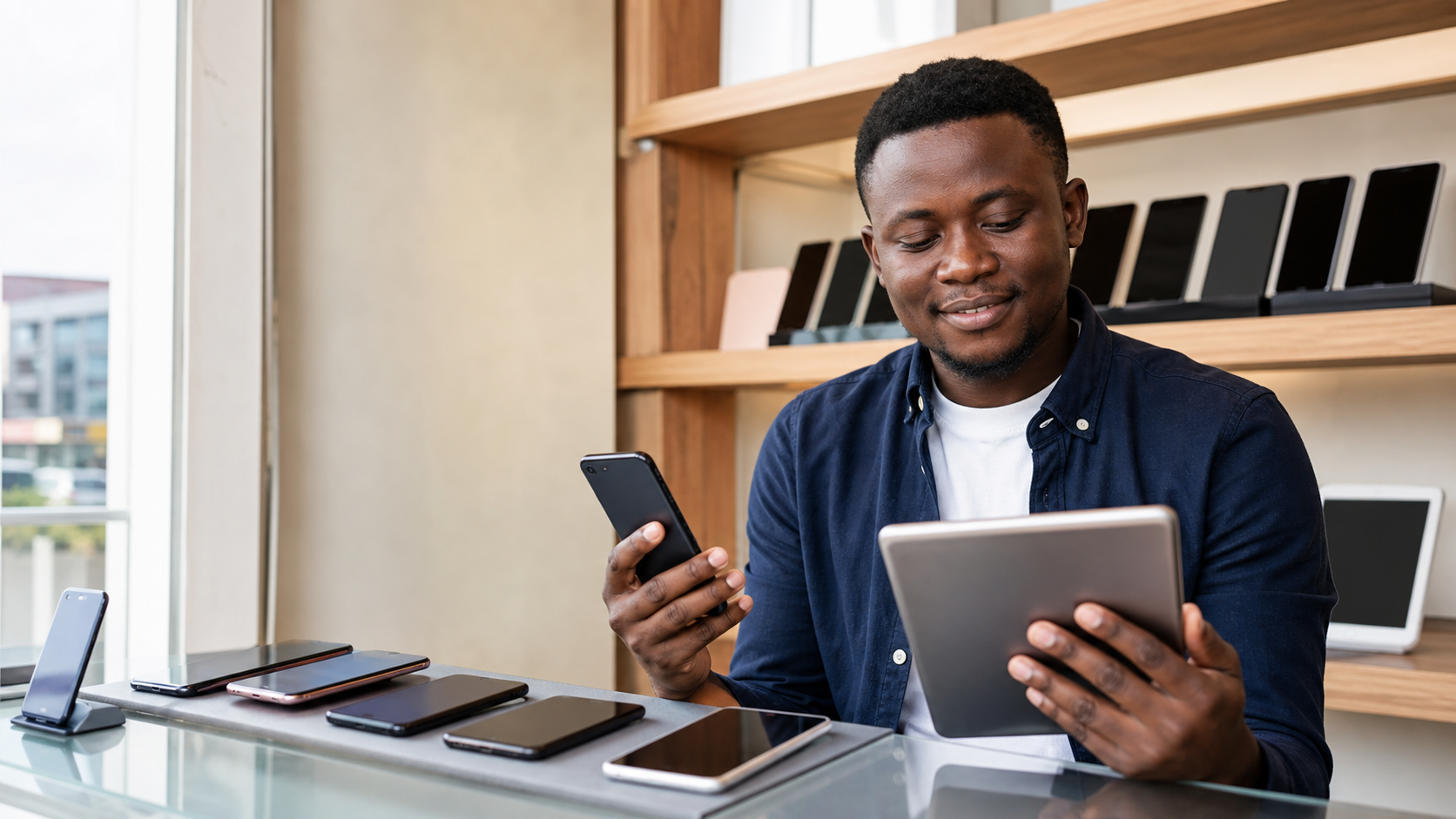
Why does the same "price?" message keep landing in your inbox? Every repeat answer burns selling time and pushes a ready buyer to the next seller. A simple catalogue of shareable product links fixes it: each phone or tablet shows its price, condition, specs and M-Pesa payment details on one page, so buyers on WhatsApp, TikTok or Instagram reach checkout instead of a long chat thread.
If you already post phone photos in your WhatsApp status or on your TikTok page, you are halfway there. The missing step is a clean product link that shows the price, condition, and your payment details. Once that link exists, every social post becomes a sales channel.
Start with a catalogue, not a chat thread
The biggest mistake Kenyan phone sellers make is trying to sell through DMs and group chats. A buyer asks "price?", you reply, then you send screenshots, then you negotiate, and one hour later they ask for the same specs again. A public product page removes that back - and-forth.
A simple catalogue for phones and tablets only needs four things:
- Product title with brand, model, and storage (for example, Samsung Galaxy A15 128GB)
- Condition - new, used, or refurbished, plus any visible flaws
- Price in Kenyan shillings, including whether delivery or insurance is extra
- Clear photos - front, back, screen on, and any scratches or dents
When you have those details in one place, you can share the same link everywhere. You do not need a full ecommerce website to start. A single product link from a catalogue tool like LinkDuka works on any social app and works with M-Pesa payment on the same page.
What you need before you list a phone or tablet
Think of each listing as a mini contract. Kenyan buyers are cautious about expensive electronics because fake phones, swapped screens, and stolen devices are common concerns. Preparing the following before you publish will reduce disputes and refund requests:
- Your business name or seller identity - a registered business name, or at least a consistent seller profile that matches your M-Pesa name
- A valid KRA PIN for issuing invoices and tracking sales
- The device IMEI number - ask buyers to confirm it in the listing or before delivery; this helps prove the device is not stolen and makes after-sales support easier
- Proof of purchase for new stock - warranties from distributors can be passed to the buyer
- A clear delivery area - whether you sell countrywide or only within Nairobi, Mombasa, Kisumu, and other major towns
- Your return or exchange policy - even a short line like "No refunds after 48 hours unless the device is dead on arrival" avoids confusion
If you are operating as an individual, you can still sell, but formalising your business through the Business Registration Service (BRS) makes it easier to open bank accounts, get distributor terms, and build buyer trust. You can register a business name at Business Registration Service Kenya.
Pro tip: Keep every device's IMEI and serial number in a simple spreadsheet before you post the listing. When a buyer asks "is this original?", you can reply with confidence because you already have the facts.
How to list phones and tablets online in Kenya, step by step
Follow this exact workflow so you do not miss a payment or send a device without proof:
- Create one product link per device. Do not lump ten phones together on a single page. Each model and condition gets its own link so the buyer knows exactly what they are paying for.
- Write a detailed description. Include storage, RAM, colour, network compatibility (2G, 3G, 4G, 5G), battery health for used phones, and whether the phone is carrier-locked to Safaricom, Airtel, or Telkom.
- Set your price and delivery fee. The total should be visible to the buyer before they pay.
- Enable M-Pesa checkout. LinkDuka lets you attach your M-Pesa Paybill or Till number so the buyer pays directly from the product page, and you receive the money in your business M-Pesa account.
- Share the link on your social channels. Put it in your WhatsApp status, pin it on your TikTok bio, post it to Facebook Marketplace, and share it on Instagram or X with a short video.
- Mark the item as sold once payment is received. This keeps your catalogue honest and prevents double-selling the same device.
This workflow answers the common question "How can I sell phones and tablets online in Kenya?" It is not about being a big ecommerce brand; it is about turning one ready buyer into a completed order with less chat and fewer mistakes.
Choose the right social channel for each listing
Different social networks reach different buyers. You do not need to be everywhere at first, but you should match the platform to your customer.
| Platform | Best for | How to sell using product links |
|---|---|---|
| Quick follow-ups with interested buyers who already trust you | Share the product link in status and in direct chats; use a WhatsApp Business account so your catalogue and automated response look professional | |
| TikTok | Younger buyers, especially for affordable or mid-range phones | Post a 30-second video showing the screen, camera, and battery; pin the product link in your bio |
| Fashion-conscious buyers and students | Use stories with the link sticker; post to your shop feed; add the LinkDuka page to your Instagram bio | |
| Wider audience including older buyers; good for family-used phones | Publish the listing in local buy - and-sell groups; connect your shop page if you use Meta Business Suite | |
| X | Tech enthusiasts and quick flash sales | Share the product link with a photo and clear price; reply to quote tweets publicly |
For Facebook and Instagram, you can set up a proper shop through Meta Business Suite, but a dedicated product link is faster to launch and does not require Meta approval. If you already run ads on Meta, link your product page in the ad description so buyers do not scroll through comments to find a phone number.
TikTok is now a serious search engine for electronics in Kenya. A short video titled "Samsung A15 128GB at Ksh 24,000 in Nairobi" with a visible product link can outwork an hour of cold messaging. Start with the products you can photograph well, not the entire inventory.
How to price phones and tablets online in Kenya
Price is the reason a buyer clicks your link or scrolls past it. For new devices, your margin usually comes from the distributor price, not from adding huge markups. For used devices, Kenyan buyers expect a 10 - 25% discount compared to a new unit, depending on condition and battery life.
A practical pricing formula:
- New device: (distributor price + delivery cost) × 1.10 - 1.20 to cover your effort and the risk of stock sitting unsold
- Used device: (new current price × 0.75 - 0.90) adjusted for cosmetic condition, battery health, and whether the box and charger are included
- Refurbished device: price between used and new, but always state what was repaired (new screen, new battery) and any warranty you offer
Compare your price with active marketplace listings on the same day. Do not rely on prices from months ago; phone prices in Kenya can shift with the dollar exchange rate, so check current distributors and supermarket prices for new models. If you cannot find a comparable listing, look at the import price plus tax, or check the Kenya Revenue Authority's guidance on VAT for electronics (smartphones and tablets generally attract VAT under current KRA rules). You can verify obligations at the Kenya Revenue Authority. Use the free VAT calculator to add 16% VAT to a price or remove it from a total.
Common mistake: Setting a price and calling it negotiable. In a product link, "negotiable" confuses the buyer and attracts lowball offers. Instead, price at your lowest acceptable amount and state "price is final" if you want serious buyers only.
What to include in every phone and tablet listing
An unclear listing creates unnecessary follow-up messages. Include everything a buyer in Kenya would ask in a voice note:
- Exact model and variant (for example, iPhone 13 128GB, not "iPhone")
- Storage capacity and RAM
- Condition (new, open box, used, refurbished)
- Battery health percentage for used phones
- Network compatibility and whether it is locked
- Physical defects, including scratches on the screen or a replaced back cover
- Accessories included (charger, cable, box, original receipt)
- Warranty information (distributor warranty or your own one-month repair promise)
- Delivery cost and estimated arrival time
- M-Pesa payment instructions and confirmation number requirement
A detailed description is not just for the buyer. It protects you when a customer claims the phone arrived different from what was advertised. Your product link becomes proof of what you promised.
Accept M-Pesa when the buyer says "I'll take it"
Yes, you can accept M-Pesa when you sell phones and tablets online in Kenya, and for most small sellers it is the only payment method you need. M-Pesa is the default checkout for Kenyan mobile commerce, and Safaricom's platform is built to handle buyer-to-seller transfers across all networks. You can receive M-Pesa using a Paybill number, a Till number, or a Buy Goods code.
With a LinkDuka product link, you connect your M-Pesa details once, and then every product page shows how much to pay and where to send the money. The buyer pays without leaving the page. You get the M-Pesa confirmation message on your phone, then you arrange delivery.
Two practical rules:
- Do not ship before you confirm the M-Pesa credit. The confirmation SMS is not enough; log into your M-Pesa app and check your balance or statement.
- Ask the buyer to send the confirmation code. A screenshot can be fake, but the STK push message on the buyer's phone plus your own M-Pesa history gives you a clean audit trail.
To understand the M-Pesa payment flow and options better, read LinkDuka's guide on how to accept M-Pesa payments as a Kenyan seller.
Delivery steps that save your money and reputation
Phones and tablets are small, expensive, and easy to lose in transit. Follow these delivery steps:
- Prefer delivery after payment. Do not offer cash on delivery for your first few sales unless you are using a trusted courier with COD protection, because buyer fraud increases with high-value electronics.
- Use a courier with tracking. Boda boda delivery works for a Ksh 500 charging cable, not for a Ksh 30,000 phone. Use a courier that gives a tracking number and requires an OTP or ID verification on delivery.
- Purchase delivery insurance for devices above Ksh 20,000. Some courier services include it; ask beforehand.
- Take a video when packaging the device. Show the phone screen on, the IMEI on the packaging, and the sealed box. Send that video to the buyer before dispatch.
- Collect the buyer's M-Pesa name and location before dispatch. If the buyer wants someone else to receive the phone, write the receiver's name and ID number in the delivery instructions.
- Get proof of delivery. A signature or SMS confirmation from the courier protects you if the buyer later claims the phone never arrived.
If you are selling within Nairobi, you can offer a meet-up point at a secure public place such as a mall food court or a police station parking lot. Meet-ups avoid courier costs, but they still require you to verify the M-Pesa payment on your phone before handing over the device.
Trust signals that make Kenyan buyers pay first
Kenyan buyers are right to be suspicious. Phone scams are common on social media. You can stand out by making your legitimacy visible:
- Use your real name and face. A seller profile with a clear profile photo and contact number converts better than one with a logo only.
- Share your physical location. "We sell from a shop near Kencom Bus Stop" beats "based in Nairobi" because the buyer knows they can find you.
- Create a Google Business Profile. A business profile with your phone number, opening hours, and location helps buyers verify you exist and gives you a free website-like page. Set it up through Google Business Profile.
- Get a business registration number. You do not need a huge company, but an official business name makes your invoice legitimate. Register through the Business Registration Service Kenya.
- Publish your KRA PIN. Many corporate buyers and serious individuals ask for a PIN before paying for electronics above Ksh 50,000.
- Handle buyer data responsibly. Collect only the name, phone number, and delivery address you need. Do not post buyer screenshots or share their ID numbers. The Office of the Data Protection Commissioner has guidance on consent and data minimisation, and following it keeps you safe.
- Show real product photos. Factory renders do not show the actual condition of a used phone. Buyers notice when photos are copied from a review site.
- State your after-sales policy. A 24-hour dead-on-arrival replacement guarantee is more powerful than a low price.
You do not need to have a physical shop. A registered business, an active Google profile, and a habit of sending proper invoices will convince a careful buyer that you are not a WhatsApp thief.
Getting started: turn your next listing into a product link
If you are reading this, you probably already have one phone or tablet you want to sell. Do not wait until you have a full inventory. Create a single product link for that one item, share it on your strongest social channel, and close the sale using M-Pesa.
The fastest way is to use LinkDuka's shop and product-link workflow. You will create a catalogue, receive a shareable link for each product, and connect your M-Pesa checkout. You can see exactly how the process works on the LinkDuka "How it works" page, then come back here to apply the pricing and delivery tips above.
After your first sale, repeat the same steps with new stock. Keep every product description complete, update your prices when the market changes, and do not skip the video of the packaged device. That consistency builds a phone-selling business that buyers can trust, even when you are selling entirely through social media.
Quick checklist before your first sale
To close this guide in one screen, review this list before you publish your first phone or tablet listing:
- Product title includes brand, model, and storage
- Condition clearly stated (new, used, refurbished)
- Price in Ksh, including delivery fee or stating that delivery is extra
- At least four clear photos showing the actual device
- IMEI or serial number recorded
- Battery health stated for used devices
- M-Pesa Paybill or Till number connected to your product page
- Delivery method, courier, and cost confirmed
- Your business name and KRA PIN ready for invoicing
- Google Business Profile link or your physical location visible
- Return policy in the product description
Then share the product link on WhatsApp or TikTok and wait for a serious buyer who has already seen the price, the condition, and the payment steps. That is how to sell phones and tablets online in Kenya without burning your day on repeated chat threads.
Was this post helpful?
Discussion
Comments