

Solar Wholesale for Kenyan Resellers: What Actually Sells
Why does the same lantern that sells on Monday sit on the shelf by Friday? A bad batch costs you more than one sale: it costs you the neighbours that buyer warns, and the margin you needed that afternoon. Stock what Kenyan buyers actually want, lighting, phone charging and small backup power, then vet suppliers hard. Match your range to real local needs, and the till stays busy.
This guide covers the essentials for Kenyan resellers who want to enter or expand in the solar market. It walks through product selection, quality checks, pricing, payments, delivery, online selling, and after-sales support. Whether you operate a shop in Nairobi, a stall in Kisumu, or sell through social media from your phone, the same principles apply.
How do I choose solar products to resell?
Start with the reality of your customers, not with the flashiest gadget. A customer buying solar in Kenya usually wants one of three things: lighting for the home, phone charging, or power for a small appliance like a radio or TV. Your product range should map directly to those needs.
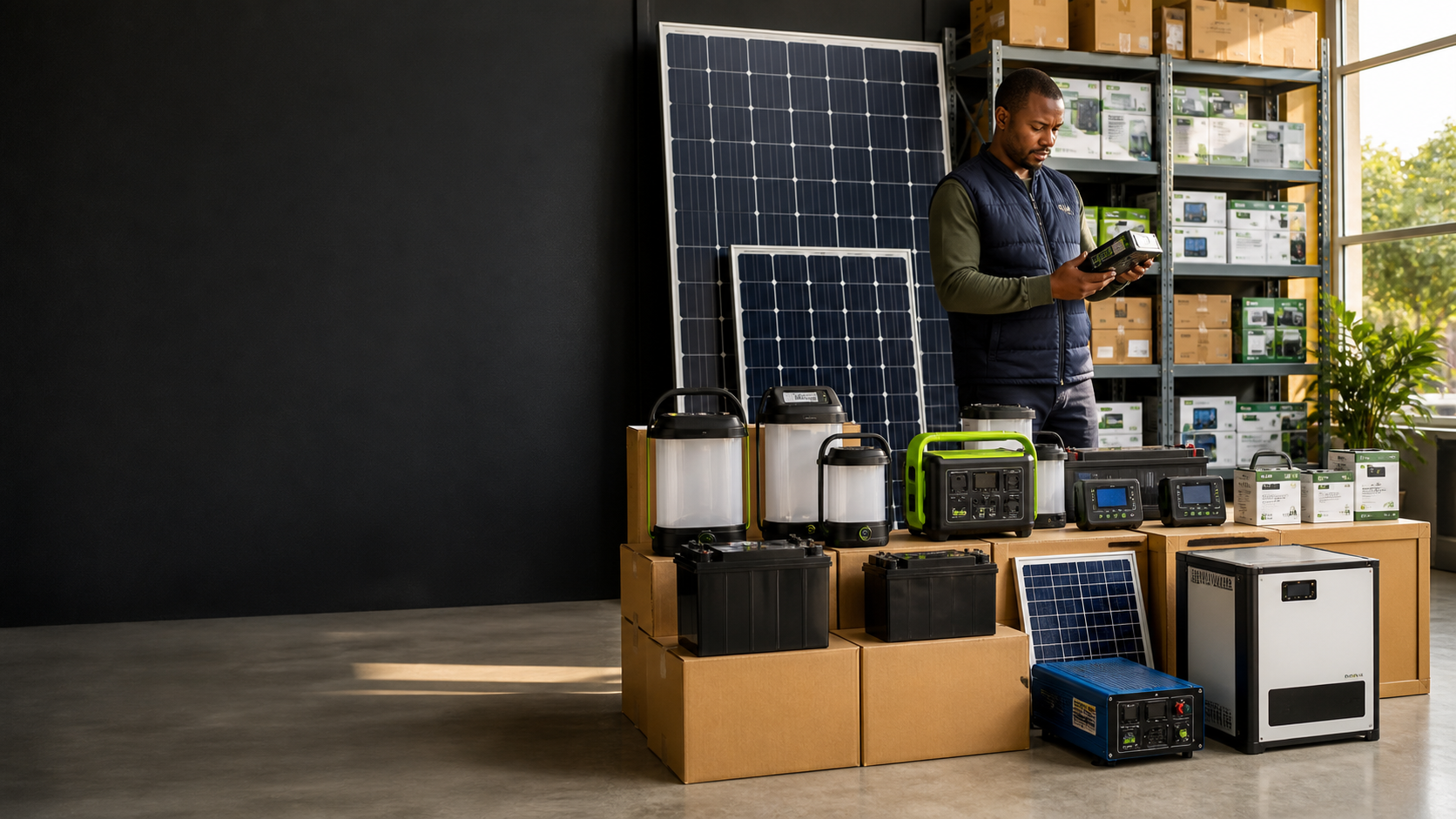
Entry-level products such as solar lanterns, portable phone chargers, and small home lighting kits have the broadest appeal. They are affordable, easy to carry, and do not require complex installation. Moving up, you can stock solar panels of 10W to 100W, charge controllers, batteries, and inverters for customers who want to run several devices or small businesses. Solar water heaters and large systems are usually project-based and require technical knowledge, so they are best left to specialists.
Pay attention to your local context. If you are in an area with many smallholder farmers, focus on lighting and phone charging. If you are near a market centre with shops that close early due to darkness, pitch portable power stations to shop owners. Also consider the voltage and socket types commonly used in your area. Standardising on 12V systems and USB outputs will reduce confusion for you and your customers.
Volume matters too. Do not spread yourself thin. Start with two or three product categories and become known for them. A reseller who stocks fifty different lights but understands none of them will lose business to someone who stocks five and can explain wattage, charging time, and warranty.
What should I check before buying wholesale?
Before you send money to any supplier, verify the basics. A genuine solar product has clear branding, a visible model number, and technical specifications on the packaging or the device itself. If the product has no brand name, no manual, and no manufacturing details, treat it with suspicion.
Request samples before committing to a full order. Buy one unit, test it in real conditions, and have it checked by someone with technical knowledge if possible. Charge it fully, run it through the claimed number of hours, and see how long it takes to recharge. Check the physical quality of the casing, the wiring, and the connectors. Solar panels should come with junction boxes and properly sealed cables. Batteries should be from known sources and clearly labelled. There are too many so-called solar products in Kenya that are simply rechargeable torches with a small panel glued to the back. A sample will help you avoid becoming the reseller known for selling "one-week" solar lamps.
Ask about certificates. Products backed by recognised standards, such as Kenya Bureau of Standards approval or international quality marks like IEC or CE, give you and your customer some protection. Be careful, though: certificates can be copied. If a supplier claims a certificate, ask to see it and, where possible, verify the issuing body.
Finally, check your supplier's standing in the market. How long have they been operating? Do they have a physical office or warehouse you can visit? What do other resellers say about their delivery time and responsiveness? In this industry, the supplier is your partner. A supplier who disappears after a bad batch will leave you handling angry customers alone.
How do I price solar products?
Pricing in solar is a balance between staying competitive and keeping yourself safe. Start by calculating your full landed cost. This is the wholesale price of the product plus transport to your shop or doorstep. Do not forget the small costs: packaging, M-Pesa transaction fees, and the time you spend collecting goods.
From there, determine your margin. Many resellers aim for a gross margin of 20% to 40% on fast-moving items. Smaller, cheaper items like phone chargers can carry a higher percentage margin, while larger panels and systems will have lower percentage margins but bring in more shillings per sale. Always know your minimum acceptable price before you start negotiating with a customer.
Compare your prices with other resellers and with retail shops in your area, but do not become obsessed with being the cheapest. Customers buy solar products for reliability. If you offer a warranty, honest advice, and a clear explanation of how to use the product, people will pay a reasonable premium. Position yourself as someone solving a problem, not as a discount bin.
Build a price list that separates cash prices from credit prices if you plan to offer payment terms. Be very careful with credit in this market. If you do it, keep it small, short-term, and limited to customers you know personally. Many solar resellers have been pushed out of business by unpaid instalments.
M-Pesa and delivery
M-Pesa is the backbone of most small business transactions in Kenya. For wholesale orders, you should ask for a deposit, commonly 30% to 50%, before ordering goods from your supplier. Then collect the balance before dispatching delivery. When dealing with new customers, consider full payment upfront until you build a record with them.
Be aware of M-Pesa transaction costs. These eat into your margins, especially on smaller items. If a customer is buying a low-cost item, you might be better off meeting them in person and receiving cash instead of paying transfer fees. For larger orders, factor the withdrawal and payment charges into your pricing.
Delivery is a practical matter that can make or break customer trust. If you are using a courier or boda boda rider, confirm who pays for delivery and what happens if the product is damaged in transit. Solar panels and batteries are fragile. Pack them with bubble wrap or cardboard protection. For fragile items, consider whether you need insurance covering damage during transit.
How can I sell solar products online?
Selling online does not mean you need a full e-commerce website. For most Kenyan resellers, a simple and effective approach is running a Facebook page, a WhatsApp Business account, and using marketplaces such as Jiji. Post clear photos of the actual products you have in stock, including close-ups of the labels and specifications. Videos work even better: show a lamp charging in the sun, a panel powering a TV, or a power bank charging a phone.
Write honest product descriptions in simple language. Avoid copying manufacturer claims without testing them. If a customer asks a question, answer it quickly and politely. WhatsApp status updates with your current stock and prices keep you visible to your contacts without paying for ads. Many resellers create broadcast lists for repeat customers and post daily offers.
Platforms like Facebook Marketplace and Instagram are good for building visibility, and you can link your shop within your bio. For a more structured presence, list your products on platforms that connect resellers with vetted suppliers and stock information. LinkDuka serves as a shop and product-link platform where you can connect product details to customers in a more organised way. You can also learn how to strengthen your online presence by checking features that help small sellers list and manage inventory. The important part is that your online shop reflects what you actually have in stock and that you respond fast.
One caution: beware of fake online buyers who claim they have paid and ask you to "release" goods before you check your M-Pesa statement. Always confirm the payment has landed in your account, not just that you received a message.
What should I know about delivery and after-sales support?
Solar products often fail from improper use, not manufacturing defects. Customers over-discharge batteries, use the wrong adapters, expose controllers to rain, or connect panels incorrectly. Your after-sales support should start with education at the point of sale. Show the customer how to set up the product. Give them a written note with basic instructions. Share your phone number and encourage questions.
Set a clear and simple warranty policy before you start selling. Common practice for small solar items is a warranty of a few months to a year on the light or device, and a separate warranty on the panel and battery. Put the warranty terms in writing, even if it is a simple receipt with a stamp. Keep records of what you sold, the serial number if there is one, and the date. If an item fails within the warranty period, know whether you will replace it, repair it, or send it back to the supplier. Do not promise what your supplier will not honour, or you will carry the cost yourself.
For delivery, set realistic timelines. If you promise same-day delivery in Nairobi, make sure a rider is available. If you are sending goods to another county, give yourself an extra day to account for transport delays. Always share the delivery tracking or the rider's phone number with the customer.
Common mistakes
One major mistake is chasing the lowest wholesale price without regard for quality. Counterfeit and substandard products flood this market. Once customers realise the product does not work, your reputation is gone. Another mistake is stocking only hardware without understanding the technology. If you cannot explain how many hours a lamp lasts or whether a panel suits a customer's battery, you will lose the sale to someone who can.
A related mistake is ignoring transport and transaction costs. A price looks good on paper, but after you pay for delivery and M-Pesa charges, your margin disappears. Overstocking is also risky because solar batteries degrade over time, and models change quickly. Stock what you can sell within a reasonable period. Finally, many resellers neglect after-sales support. They treat the sale as the end of the relationship instead of the beginning. This is a mistake because referrals are your cheapest form of marketing.
A practical checklist
Before buying stock:
- Test a sample of each product
- Confirm the supplier has a physical presence and history
- Check for clear branding and specifications
- Ask for certificates and verify them where possible
- Compute your full landed cost including transport and fees
Before paying:
- Use M-Pesa with a clear transaction reference
- Pay a deposit only for custom or large orders
- Confirm the delivery timeline in writing
Before selling:
- Test each unit and understand its features
- Prepare a short description in simple language
- Set a warranty policy that your supplier supports
- Price to a gross margin that covers costs and wastage
After the sale:
- Give the customer clear usage instructions
- Record the sale, date, and warranty terms
- Follow up after a week to check performance
- Ask satisfied customers for referrals
Conclusion
The solar market in Kenya rewards resellers who are patient, honest, and prepared. The opportunities are significant, but the market also punishes those who rush into stocking cheap goods from unknown suppliers. Choose a modest product range, verify quality with samples, set clear margins, and lean on M-Pesa for fast and traceable payments. Build your presence online using social media and product-link platforms. Treat after-sales support as part of the product itself. By following this approach and using the checklist above, you can build a solar reselling business that grows one satisfied customer at a time.
For more guidance on setting up a seller storefront and product links, see LinkDuka features.
Was this post helpful?
Discussion
Comments